

Understanding 401k 2026 Contribution Limits and IRS Updates
The biggest question most people ask about 401k 2026 is simple:
“How much can I contribute?”
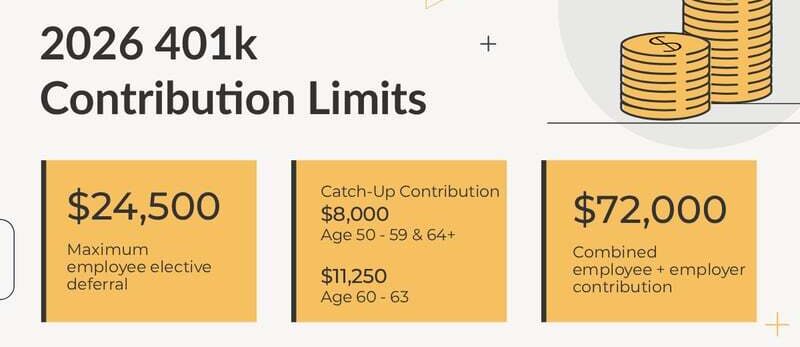
Contribution limits typically increase with inflation, and by 2026, projections suggest meaningful adjustments. While the IRS final numbers will be confirmed closer to the year, we anticipate continued upward indexing similar to recent increases.

Expected Contribution Limit Adjustments
If current inflation trends continue, the employee deferral limit for 401k 2026 could rise above recent thresholds. That means more tax-deferred growth potential — and that’s powerful.
For employees under 50, higher contribution caps mean:
-
Larger pre-tax deductions
-
Reduced taxable income
-
More aggressive retirement growth
For those 50 and older:
-
Catch-up contributions are expected to remain available.
-
New tiered catch-up rules introduced under SECURE 2.0 may further evolve by 401k 2026
In fact, legislation such as the SECURE Act 2.0 has already started reshaping retirement planning, and its extended impact will continue influencing 401k 2026 strategies. You can review legislative updates directly through the IRS website here: https://www.irs.gov/retirement-plans
Employer Matching Considerations
Employers are also adapting. By 401k 2026, more companies may:
-
Offer Roth matching options.
-
Increase auto-enrollment percentages
-
Expand safe harbor provisions.
If you own a business, this is critical. Adjusting your retirement benefits structure before 401k 2026 could improve tax efficiency while helping attract top talent.
Tax Implications of 401k 2026 That Could Help or Hurt You
Let’s talk taxes — because that’s where 401k 2026 really matters.
Pre-Tax vs. Roth 401k in 2026
One of the most significant conversations around 401k 2026 involves Roth contributions.
Under recent changes, certain high-income earners may be required to make catch-up contributions on a Roth basis. That means:
-
You pay taxes now
-
You withdraw tax-free later.
Depending on your projected retirement tax bracket, this could be brilliant… or it could backfire.
If tax rates increase by 2026 — which many analysts expect due to expiring provisions from the Tax Cuts and Jobs Act — then pre-tax 401(k) contributions could become even more valuable.
Required Minimum Distribution (RMD) Updates
The RMD age has already shifted under the recent law. By 401k 2026, we may see:
-
Continued adjustments to RMD age thresholds
-
More flexibility for Roth 401(k)s
-
Penalty reduction for missed RMDs
Failing to understand RMD rules can result in significant penalties. Planning for 401k 2026 ensures compliance and tax efficiency.
401k 2026 for Small Business Owners and Self-Employed Individuals
If you run a business, 401k 2026 presents both opportunity and responsibility.
Solo 401(k) Strategy in 2026
Self-employed professionals can benefit tremendously from Solo 401(k) plans. By 401k 2026, maximum combined employer and employee contributions are expected to increase further.
This means:
-
Potentially sheltering over $70,000 annually.
-
Significant reduction in taxable income
-
Accelerated retirement growth
However, compliance rules are tightening. Documentation, nondiscrimination testing, and Roth options must be structured carefully.
Safe Harbor and Profit-Sharing Planning
Business owners preparing for 401k 2026 should evaluate:
-
Safe Harbor 401(k) design
-
Profit-sharing allocation strategies
-
Defined benefit combo strategies
Done correctly, this could dramatically reduce your tax liability while boosting executive retirement accounts.
Done poorly? You risk audits, penalties, and employee dissatisfaction.
Investment Strategies to Maximize 401k 2026 Growth
A 401(k) isn’t just about contributions. It’s about what you do with the money.
Asset Allocation for 2026 and Beyond
As we approach 401k 2026, market volatility remains a factor. Strategic asset allocation is key.
Consider:
-
Diversified index funds
-
Target-date funds
-
Bond allocation adjustments
-
International exposure
Avoid emotional investing. Don’t panic during downturns. 401k 2026 planning should focus on long-term compounding, not short-term noise.
Rebalancing and Risk Management
By 2026, many investors may need to:
-
Rebalance portfolios
-
Adjust risk tolerance
-
Consider inflation-protected securities
Inflation risk remains real. Ignoring it could erode retirement purchasing power.
Common 401k 2026 Mistakes That Could Cost You Thousands
Let’s be blunt — mistakes are expensive.
Not Increasing Contributions
One of the most damaging errors heading into 401k 2026 is keeping contribution levels stagnant despite higher limits.
Even a 1–2% increase in deferral rates can add tens of thousands over time.
Ignoring Beneficiary Updates
Life changes:
-
Marriage
-
Divorce
-
Birth of a child
If your beneficiary designation isn’t updated before 401k 2026, your retirement savings could end up in the wrong hands.
Overlooking Fee Structures
Many investors lose significant returns to high expense ratios. Review:
-
Fund expense ratios
-
Administrative fees
-
Advisory costs
Fee awareness is a critical component of 401k 2026 planning.
How 401k 2026 Impacts Immigration and International Professionals
For immigrants and visa holders, retirement planning adds complexity.
If you’re on:
-
H-1B
-
L-1
-
Green Card pathway
You must consider:
-
Tax residency status
-
Treaty implications
-
Cross-border tax planning
With 401k 2026, portability and rollover options become especially important for individuals who may relocate internationally.
Proper coordination between tax planning and immigration strategy can prevent costly cross-border taxation.
Advanced 401k 2026 Planning for High Earners
High-income professionals face additional considerations under 401k 2026.
Backdoor Roth Strategy
If income limits prevent direct Roth contributions, a backdoor Roth strategy may be useful — but it must be structured carefully to avoid pro-rata rule complications.
Mega Backdoor Roth Opportunities
Some employer plans allow after-tax contributions beyond standard limits. By 401k-2026, these strategies may gain even more popularity among executives and physicians.
FAQs About 401k-2026
What will the 401k contribution limit be in 2026?
The exact limit will be announced by the IRS, but inflation adjustments suggest it will likely increase beyond current levels.
Will catch-up contributions change for 401k-2026?
Yes, SECURE 2.0 introduced income-based Roth catch-up rules that may further evolve by 2026.
Should I choose Roth or traditional for 401k-2026?
It depends on your current and future tax bracket projections. Strategic tax planning is essential.
Can small business owners benefit more from 401k-2026?
Absolutely. Safe harbor, profit-sharing, and Solo 401(k) plans offer major tax advantages.
Will required minimum distributions change by 2026?
RMD ages have already increased, and additional flexibility may continue.
How often should I review my 401k before 2026?
At minimum, annually — ideally with a qualified tax and retirement professional.
Final Thoughts on 401k-2026 Planning
There’s no question about it — 401k-2026 represents both opportunity and risk.
Handled correctly, it can:
-
Lower your tax burden.
-
Increase retirement wealth
-
Strengthen business strategy
-
Provide long-term financial security.
Ignored or misunderstood, it could:
-
Trigger unnecessary taxes
-
Reduce growth potential
-
Create compliance issues
-
Cost you thousands
At Syed Professional Services, we specialize in tax strategy, retirement planning coordination, and business structuring to ensure our clients are prepared for 401k-2026 and beyond.
If you’re serious about protecting your future, don’t wait until 2026 arrives.
Start planning today.

