

5 Devastating Mistakes to Avoid When Claiming the Standard Deduction 2026 – Ultimate Planning Guide
Every year, millions of taxpayers automatically claim the standard deduction without a second thought. For most, it’s the right move—simpler, faster, and often larger than itemizing. But as we approach the standard deduction 2026, a combination of inflation adjustments, sunsetting tax provisions, and overlooked eligibility rules creates a minefield that can cost you thousands of dollars or even trigger an IRS audit. At Syed Professional Services, we’ve seen how a misunderstood standard deduction 2026 derails careful financial plans, especially for immigrants navigating the intersection of tax residency and immigration status. This guide will expose five devastating mistakes taxpayers make with the standard deduction 2026 and arm you with the knowledge to transform it into a powerful tax-saving tool.
The standard deduction 2026 isn’t a static number you can ignore until tax season. It’s a dynamic figure shaped by inflation indexing and legislative schedules. Under current law, the temporarily increased standard deduction amounts enacted by the Tax Cuts and Jobs Act (TCJA) are set to expire after 2025. That means the standard deduction 2026 will likely be significantly lower unless Congress acts. Failing to plan for that shift is just one of the five critical errors we’ll unpack. But first, let’s establish exactly what the standard deduction 2026 is and why it affects not only your tax liability but also your immigration-related financial obligations.
What Is the Standard Deduction 2026?
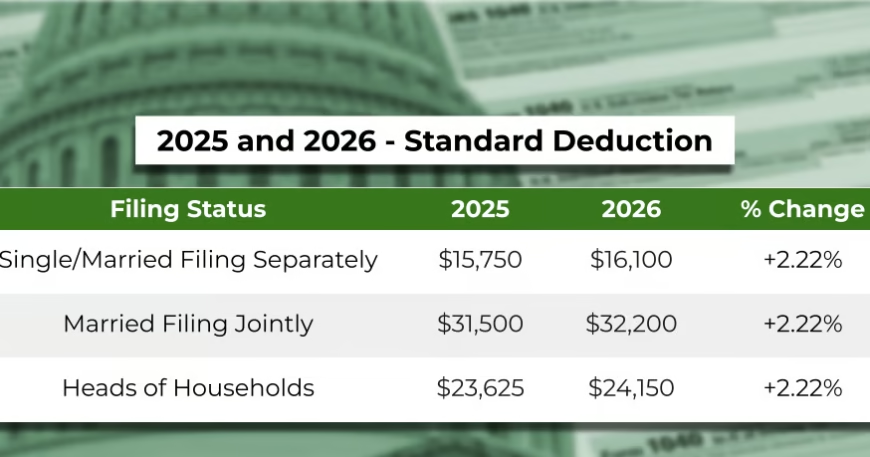
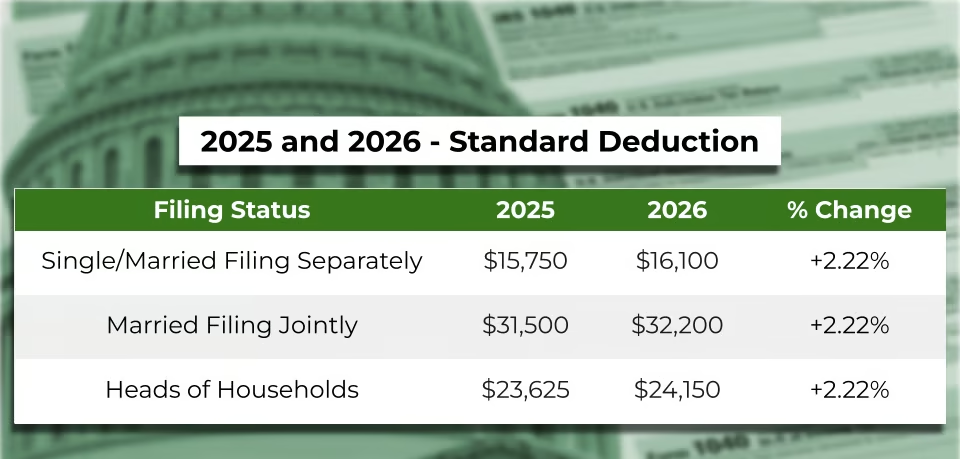
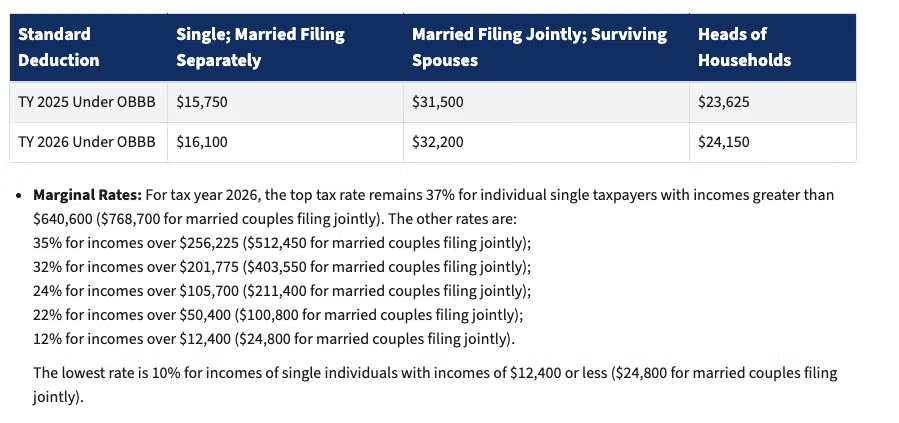
The standard deduction 2026 is the base amount of income that is not subject to federal income tax for the 2026 tax year (the return you file in early 2027). It reduces your adjusted gross income (AGI) to arrive at taxable income. The amount of the standard deduction 2026 depends on your filing status—single, married filing jointly, head of household, or married filing separately—and whether you are age 65 or older or blind. The IRS adjusts the standard deduction 2026 annually for inflation using the Chained Consumer Price Index for All Urban Consumers (C-CPI-U). However, the current elevated amounts are scheduled to revert to pre-2018 levels (adjusted for inflation) in 2026 under the TCJA sunset. This means the standard deduction 2026 could be roughly half of what it was in 2025 for many filers—a shocking drop if you’re not prepared.
Understanding the standard deduction 2026 is crucial for everyone, but it carries extra weight for immigrants. Your eligibility for the standard deduction 2026 depends on your tax residency status. Nonresident aliens generally cannot take the standard deduction 2026 (unless they are residents of Canada, Mexico, South Korea, or India under treaty provisions for students and business apprentices). Resident aliens, including green card holders and those who pass the substantial presence test, are entitled to the same standard deduction 2026 as U.S. citizens. Syed Professional Services integrates tax and immigration expertise precisely because errors in claiming the standard deduction 2026 can impact good moral character determinations, public charge assessments, and naturalization eligibility. Now, let’s examine the five devastating mistakes you must avoid.
Mistake #1: Assuming the Standard Deduction 2026 Will Be Just as Large as 2025
This is the most widespread and dangerous assumption taxpayers make. The TCJA nearly doubled the standard deduction, and for tax years 2018 through 2025, amounts have been historically high. If Congress does not extend the provision, the standard deduction 2026 will fall dramatically. For a married couple filing jointly, the standard deduction could drop from approximately $30,000 in 2025 to around $15,000–$16,000 (inflation-adjusted from the pre-TCJA baseline) for the standard deduction 2026. That single change could push millions of taxpayers from taking the standard deduction into itemizing territory, or increase their taxable income substantially.
The mistake is building a 2026 budget or estimated tax payment plan around current deduction levels. Your withholding, estimated tax payments, and even quarterly financial goals need to account for a potentially much smaller standard deduction 2026. At Syed Professional Services, we’re already modeling standard deduction 2026 scenarios for clients, helping them adjust W-4 forms, revise estimated payment schedules, and explore itemizing strategies that may become necessary under the standard deduction 2026 regime. Don’t wait until you receive your 2026 tax forms to realize your refund has evaporated or you owe a shocking balance. Proactive planning around the standard deduction 2026 is the ultimate defense.
Mistake #2: Failing to Compare the Standard Deduction 2026 With Itemized Deductions
Even if the standard deduction 2026 shrinks, many taxpayers will reflexively take it because it’s “easy.” That’s a mistake that leaves money on the table. The correct approach is to calculate your expected itemized deductions—state and local taxes (SALT), mortgage interest, charitable contributions, medical expenses exceeding 7.5% of AGI—and compare them to the standard deduction 2026 for your filing status. With the standard deduction 2026 potentially halved, taxpayers who previously couldn’t itemize may suddenly find that bunching charitable contributions, accelerating medical expenses, or carefully timing property tax payments puts them well above the standard deduction 2026 threshold.
Itemizing requires more recordkeeping, but it can produce substantial tax savings when the standard deduction 2026 is lower. Syed Professional Services helps clients run both scenarios side by side. We analyze whether the standard deduction 2026 or itemizing yields the lower taxable income, and we recommend strategies like donor-advised funds and multi-year charitable bundling to maximize deductions in the years when the standard deduction 2026 isn’t the best option. Never assume the standard deduction 2026 is your default; let the math guide you.
Mistake #3: Overlooking Eligibility Restrictions on the Standard Deduction 2026 for Immigrants
As mentioned, the standard deduction 2026 is not available to all tax filers. A nonresident alien for tax purposes is generally barred from claiming the standard deduction 2026. This rule remains unchanged regardless of how much the standard deduction 2026 amount increases or decreases. Yet many immigrants who file Form 1040-NR inadvertently claim the standard deduction 2026, triggering a compliance red flag and potential IRS correspondence. Others incorrectly assume that because they have an ITIN, they automatically qualify for the standard deduction 2026. The determination rests on tax residency under the substantial presence test or lawful permanent resident status.
If you are an immigrant who is a dual-status filer (part-year resident, part-year nonresident), you cannot claim the standard deduction 2026 for the portion of the year you were a nonresident. Syed Professional Services carefully evaluates each client’s immigration timeline to correctly apply the standard deduction 2026 rules. We also coordinate with your immigration counsel because an improperly claimed standard deduction 2026 could be misconstrued as a false claim of U.S. residency for tax purposes—potentially complicating future applications for adjustment of status or naturalization. Your standard deduction 2026 strategy is never an isolated tax decision; it’s intertwined with your entire immigration pathway.
Mistake #4: Missing the Dependent’s Standard Deduction 2026 Rules
Taxpayers who claim dependents often misunderstand how the standard deduction 2026 applies to those dependents’ own tax filings. A dependent’s standard deduction 2026 is generally limited to the greater of $1,350 (adjusted for inflation) or the dependent’s earned income plus $450, not to exceed the regular standard deduction 2026 for their filing status. This nuance frequently leads to over-withholding or erroneous tax liability calculations, especially when a dependent college student holds a summer job and a parent incorrectly assumes they can use the full single standard deduction 2026 against all their income.
For immigrant families where dependents may have ITINs or mixed-status households, the dependent’s standard deduction 2026 rules intersect with complex dependency exemption and child tax credit eligibility. Incorrectly applying the standard deduction 2026 to a dependent’s investment income can result in unexpected Kiddie Tax implications. Syed Professional Services prepares tax returns that correctly compute each family member’s standard deduction 2026, ensuring that dependents aren’t overpaying tax and that the household’s overall tax picture is optimized within all applicable laws.
Mistake #5: Ignoring State-Level Interactions with the Standard Deduction 2026
Many taxpayers fixate on the federal standard deduction 2026 and forget that state income tax rules often diverge significantly. Some states don’t conform to the federal standard deduction 2026 at all, or they have their own deduction amounts and phase-outs. Even if the federal standard deduction 2026 decreases, your state may still offer a generous standard deduction—or the opposite. Failing to coordinate state and federal planning around the standard deduction 2026 can cause you to overpay state taxes while optimizing federal, or vice versa.
Syed Professional Services takes a holistic view, aligning your federal standard deduction 2026 strategy with your specific state’s tax code. We serve clients across various states, and we know that planning for the standard deduction 2026 in isolation is a recipe for missed savings. A coordinated approach ensures that every dollar of the standard deduction 2026 works efficiently across your entire tax burden.
Deep Dive: Projecting the Standard Deduction 2026 Amounts
While the official standard deduction 2026 amounts won’t be announced until late 2025, we can make educated projections based on inflation trends. Assuming the TCJA amounts expire and revert to pre-2018 law with inflation adjustments, the standard deduction 2026 for a single filer might be around $7,500–$8,000, and for married filing jointly, roughly $15,000–$16,000. The additional amounts for age and blindness would also apply. These figures represent a dramatic reduction from the $15,000+ and $30,000+ taxpayers have become accustomed to.
Tax planning around the standard deduction 2026 must therefore anticipate a world where itemizing becomes more common. If you’ve been donating to charity but not tracking receipts because you took the standard deduction, start maintaining meticulous records now in preparation for the standard-deduction 2026 landscape. Consider bunching property taxes or making large charitable gifts in years when you can itemize, and using the standard-deduction 2026 in alternating years if the numbers support it. This strategy, known as “bunching,” can be particularly effective in a post-TCJA environment with a lower standard-deduction 2026.
How the Standard-Deduction 2026 Affects Immigration-Related Tax Filings
For immigration cases, tax compliance is a cornerstone of good moral character. USCIS officers routinely request tax transcripts and may review how you utilized the standard-deduction 2026. If your tax returns show that you claimed the standard-deduction 2026 during a year when you were a nonresident alien and were not eligible, that inconsistency could become a credibility issue. It’s not just about the dollars—it’s about demonstrating adherence to U.S. laws.
Syed Professional Services works with clients who need to file multiple years of back taxes to satisfy USCIS or consular processing requirements. We audit prior returns for incorrect standard-deduction 2026 usage and file amended returns if necessary. If you’re planning to apply for a green card or citizenship in the coming years, now is the time to ensure your standard-deduction 2026 history is spotless. Even a simple mistake on the standard-deduction 2026 can lead to a Request for Evidence that delays your immigration case by months.
The Standard-Deduction 2026 and Self-Employed Individuals
Self-employed taxpayers face a unique interplay with the standard-deduction 2026. Business expenses are deducted directly on Schedule C, above the line, so they don’t affect your standard-deduction 2026 choice. However, self-employed individuals who also have significant personal itemizable expenses—such as a home office mortgage interest that flows to Schedule A, state and local taxes, or large medical costs—need to weigh the standard-deduction 2026 against itemizing carefully. With the reduced standard-deduction 2026, many self-employed taxpayers will find that itemizing wins. This shift may alter quarterly estimated tax calculations and affect retirement contribution decisions.
Additionally, self-employed immigrants must be especially cautious. Claiming the standard-deduction 2026 when ineligible, or failing to claim it when entitled, can skew the income figures used in I-864 Affidavit of Support evaluations. Syed Professional Services’ dual expertise in tax preparation and immigration allows us to align your Schedule C income, your standard-deduction 2026, and your immigration paperwork into a seamless, credible whole.
Maximizing Tax Benefits Around the Standard-Deduction 2026
Beyond comparing the standard-deduction 2026 to itemized deductions, there are additional strategies to maximize your tax situation:
-
Health Savings Account (HSA) contributions: Deductible above the line, so they don’t interfere with the standard-deduction 2026, yet they reduce AGI.
-
Retirement contributions: Pre-tax 401(k) and traditional IRA contributions lower AGI, making the standard-deduction 2026 relatively more powerful because your taxable income is already reduced.
-
Qualified Charitable Distributions (QCDs): For those 70½ and older, QCDs from IRAs satisfy RMDs and keep income off your return entirely, which is advantageous whether you take the standard-deduction 2026 or itemize.
-
Above-the-line adjustments: For educators, students, and others, above-the-line deductions for things like student loan interest and educator expenses reduce AGI without affecting the standard-deduction 2026.
A tax professional from Syed Professional Services can model how these tactics interact with the standard-deduction 2026, ensuring you achieve the lowest legal tax liability.
Frequently Asked Questions About the Standard-Deduction 2026
Q: When will the official standard-deduction 2026 amounts be announced?
A: The IRS typically releases inflation-adjusted tax provisions, including the standard-deduction 2026, in Revenue Procedures issued in the last quarter of 2025. However, legislative changes could alter the standard-deduction 2026 before then if Congress acts on the TCJA expirations.
Q: Can married couples filing separately both take the standard-deduction 2026?
A: If one spouse itemizes, the other must also itemize—they cannot take the standard-deduction 2026. This rule continues to apply for the standard-deduction 2026, so coordination is critical.
Q: Does the standard-deduction 2026 apply to state returns?
A: It depends on your state. Some states conform to the federal standard-deduction 2026, others use their own figures, and a few don’t offer a standard deduction at all. Syed Professional Services prepares multi-state returns that correctly handle the standard-deduction 2026 at all levels.
Q: If I am a resident alien, am I entitled to the same standard-deduction 2026 as a U.S. citizen?
A: Yes, resident aliens for tax purposes are entitled to the identical standard-deduction 2026 as U.S. citizens, subject to the same rules and limitations.
Q: What happens if I incorrectly claimed the standard-deduction 2026 in a prior year as a nonresident?
A: You should file an amended return (Form 1040-X) to correct the error. Syed Professional Services can assist with amended filings and, if relevant, provide documentation to support your immigration case.
Proactive Steps You Can Take Today
-
Estimate your 2026 taxable income using projected standard-deduction 2026 figures. Syed Professional Services can run a preliminary projection.
-
Review your withholding and adjust your W-4 to avoid underpayment penalties given a possibly lower standard-deduction 2026.
-
Start tracking itemizable expenses now—if the standard-deduction 2026 drops, you’ll need those records to decide whether to itemize.
-
Check your tax residency status if you’re an immigrant, and ensure your past and future standard-deduction 2026 claims are legally sound.
-
Consolidate tax, accounting, and immigration planning under one roof so that your standard-deduction 2026 strategy is fully integrated with your financial and immigration goals.
Why Syed Professional Services Is Your Ultimate Partner for the Standard-Deduction 2026
Navigating the standard-deduction 2026 requires more than just reading IRS publications. It demands a strategic, forward-looking approach that accounts for legislative uncertainty, individual financial circumstances, and, for many of our clients, immigration implications. Syed Professional Services brings together tax preparers, accountants, and immigration specialists who collaborate on every case. When you sit with us, the standard-deduction 2026 is not just a line on a form—it’s a decision point that we optimize within the full context of your life.
We’ll help you understand exactly how the standard-deduction 2026 affects your effective tax rate, your eligibility for credits, and your immigration paperwork. We’ll build a year-round tax plan that adapts to whatever the standard-deduction 2026 turns out to be. And we’ll be here to amend, explain, or defend that plan if the IRS or USCIS comes asking.
Don’t let the standard-deduction 2026 become a costly surprise. Call Syed Professional Services today to schedule a proactive planning session. Together, we’ll turn the uncertainty around the standard-deduction 2026 into a clear, confident strategy that protects your wealth and supports your American journey. The ultimate guide you’ve just read gives you the knowledge—now let our team put that knowledge into action for you. Your future deserves nothing less than a flawless standard-deduction 2026 plan, and we are here to deliver it.

